
Skinny Boris
The old jewelry store that Skinny Boris used as his base of operations was on Geary and 20th Ave. A faded sign hung above it — a double-headed eagle, vaguely in the style of the old Russian Imperial emblem. It’s been the same sign for as long as I can remember, going back to when this was a jewelry store run by a small-time Russian mafia guy back in the 1980s and 1990s. You could tell that something important was inside. There were multiple security cameras above the door and two big concrete barriers out front on the sidewalk — like the kind you’d see in front of embassies or government buildings. I rang the doorbell, and a voice came over the intercom, “Who are you?”
“I’m Jake. Borya—”
The door buzzed, and I heaved it open. It sat on big, fat hinges and took a lot of force to move, like a door to a bank vault. I found myself inside a decon tube and submitted myself to the usual routine: First, I raised my arms as jets of air blasted me from all directions, and a powerful vacuum vented all the radioactive particles blown off my clothes and body. Second, I took off my mask and slipped a pair of disposable plastic booties on top of my shoes. Then I walked through another door and entered a waiting room. Inside, I found a shotgun pointed at my face. “Turn around and raise your hands, and back up towards me. I gotta check you,” said the guy holding the gun. He wore slacks and a polo shirt. I noticed his hands: meaty, top of his fingers overgrown with thick black hair.
“Sure,” I said, and raised my hands in the air. I knew the drill.
He patted me down from my boots all the way up to my sleeves. As I stood there, I saw a woman appear from an inner door and quickly cross the room towards the decon tube. She was blond and tall and thin and had an uptight regal bearing. She zipped up her suit as she walked, but I caught a glimpse of exposed skin and a necklace and a diamond and something black and smooth underneath, like the top of a silk dress or a low-hanging blouse. She had the look of a arrogant anglo type who should have been in Nob Hill or Pacific Heights rather than here in this cheap and gaudy office in the Outer Richmond. She averted her gaze, staring straight ahead, as she passed.
“You can wait over there,” the guard finally said. He pointed to a black leather couch on the opposite side of the room and returned to reading a book. I sat down and looked around. The waiting room was fitted out with neoclassical Italian armchairs, a couch, and a coffee table, all of them with gold trim. The front facade of the shop — which had originally been made of glass — was now reinforced from within with thick metal slabs that had been welded together and attached to the foundation. Radiation-proof and bomb-proof, too. The place hadn’t changed much at all. It had been a year or so since I had been here — the last time was for Weenie’s funeral. He was an old childhood friend of ours and had become one of Skinny Boris’s top guys. He was shot when they had a big turf war with the Chinese groups right after the war. That’s all over now…there’s a reigning peace now. The Chinese, the Russians, the Mexicans, the Blacks, the Admirals, the hick clans out at the periphery — everyone’s been at peace for several years now. Well, at least they had been until last week.
RADIANCE, my serialized novel, continues.
Skinny was one of those unremarkable people who suddenly become remarkable at a time of crisis — the kind of people who shine when everything is collapsing. When the fallout came and organized society pretty much evaporated, he was one of those who filled the vacuum of power. In San Francisco, a few cops tried to take control, but most of the department didn’t live in the city or even anywhere close to the city and had no real connections to the community. So the cops were out. There was no big military base around, either. And so it was various locals…guys with connections…guys who just happened to have a knack for organization. Small businessmen, petty scammers, a doctor, a gangbanger, a priest. The guy that took power in the northwestern quadrant of the city — my old neighborhood — happened to be Skinny Boris.
I had known him pretty well since middle school. We were part of the same little pack of friends that remained tight all the way through high school. He was an immigrant like me but from a small Ukrainian city. He had dropped out of school and did petty crime and ran with a conman immigrant crew, ripping off credit cards, running a bootleg CD and DVD business. He was known as Skinny because there was already a Boris around, a short and fat hoodlum that people called Fat Borya. Skinny was a bit of a loser but he had a big extended family from the same Ukrainian town and knew pretty much everyone in the neighborhood, and he was easygoing and everyone liked him. When the war happened and the fallout came and the government disappeared, offering no protection, everyone panicked. The looting began immediately, and there was chaos and violence. But Skinny kept his cool. In a time of crisis, all his latent talents — which had been marginalized and repressed by society all his life — came rushing out. He had a knack for organization, a firm hand, good judgement, and the ability to use violence when necessary.
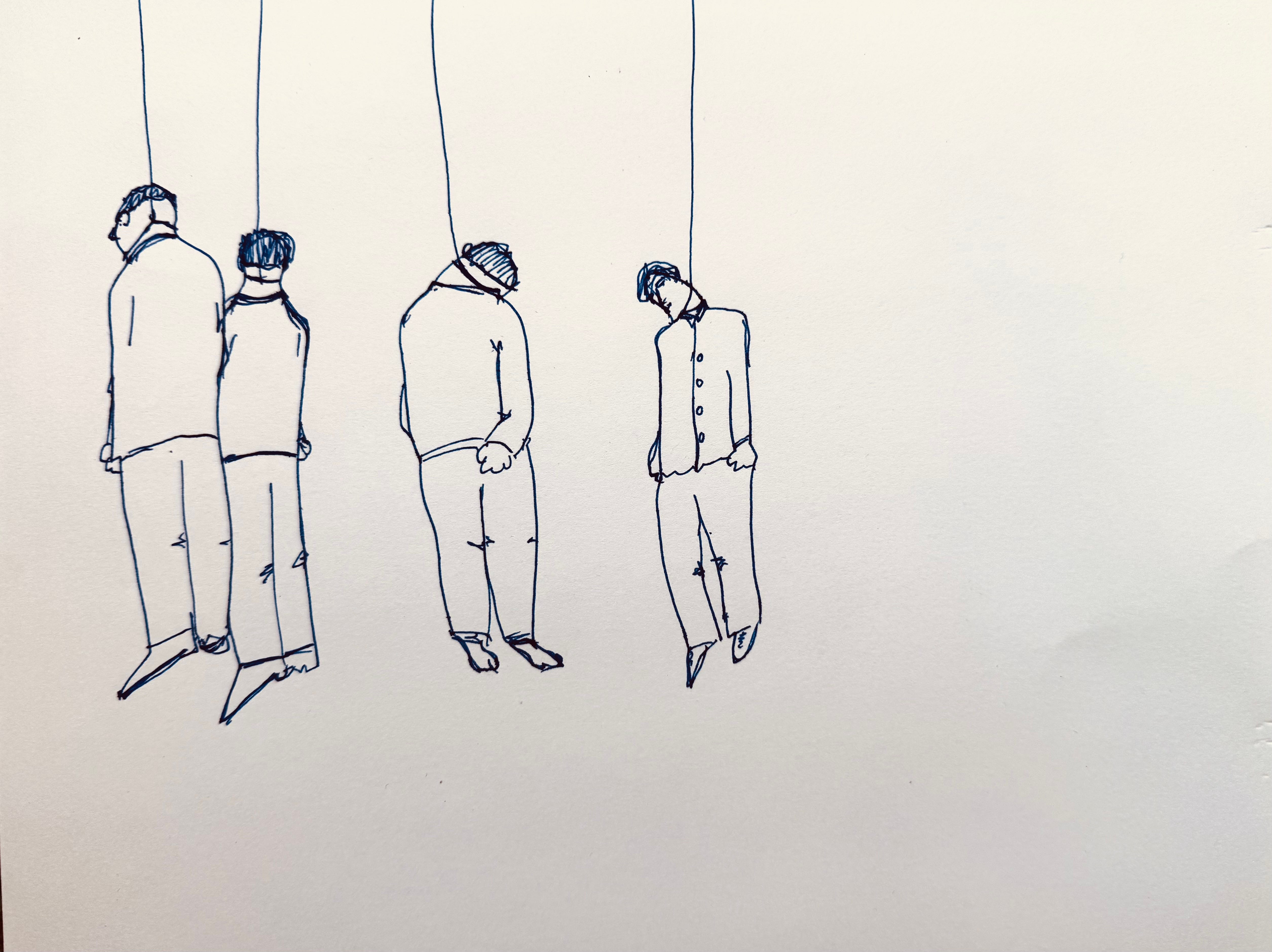
People still needed food, medicine, filters for their homes, gasoline, solar panels, pain killers, batteries, baby formula…and so he stepped into the void to provide. He leaned on his friends, his cousins, his second and third cousins, his uncles, and the friends of his many uncles and cousins, and he made himself the center of a distribution and protection system built on trade and favors. Needed baby formula or antibiotics? Running from the fallout in the north and needed a place to live? Thugs terrorizing your street? If you needed anything you couldn’t provide yourself, you went to him. And if you couldn’t pay or trade right then, he’d eventually get something out of you as payment. You’d work security at his compound, join a raiding party, knife an enemy of his — whatever you could do. And people were happy to do it. And there was something else, too. Skinny earned the goodwill of the community early by going after the sexual predators and the pimps — guys who’d take lone destitute girls and women under their wing and set up prostitution rings in exchange for food and a place to live. Skinny was a family man. He had been married to his wife since he was nineteen and he had four daughters, and so he made sure everyone knew this kind of thing was not going to be tolerated on his turf. He made a big and bloody show of it, too, publicly executing anyone who violated his rules. Any pimps he caught, he had his guys first cut off their dicks and stuff them into their mouths and then hang them up on lamp posts on Geary Boulevard. Locals would gather to watch the spectacle, clapping and cheering as they kicked and dangled on their ropes. That alone made him a folk hero in the community. People were fiercely loyal to him, and Little Russia had thousands who’d be willing to die for him. By the end of that first post-war year, Skinny was the Supreme Ruler of Little Russia…and one of the most powerful people in California. Skinny wasn’t alone, either. Others like him emerged. The Chinese had a few groups that ran a powerful operation out of Chinatown that was probably two or three times bigger than Skinny’s. Then there were the Mexican groups in San Francisco. People called them the Mexican Mafia, but really it was mixed…it was basically Spanish speaking people from all over Latin America. The blacks controlled big parts of Oakland. Indians and South Asians took control over most of Silicon Valley. The post-war world, at least in the cities, belonged to the immigrants. It was only natural. We ethnics had cohesion. Even before the war, we were more communal and used to sharing and treating our friends like close families, and this natural cohesion became useful when everything collapsed. The saddest and weakest group were the Anglos and the various watered-down and atomized Americans and deracinated corporate types. They had no support to fall back on at all. Their social groups were based on their jobs or their industries or some hobbies they had — like rock climbing or cycling or jogging. These ties weren’t strong enough to endure an apocalyptic event. They had no support to fall back on at all. And so they found themselves all alone when the fallout came and many died in those first few months. The woman that was on her way out the door, she was no doubt belonged to this class. A woman who occupied the top of the society and now she was here…as what? As Skinny’s lover? Just someone coming in asking for favors…and offering what in return?
A voice startled me out of my thoughts. “Hey. Hey! The boss is ready for you.”
