
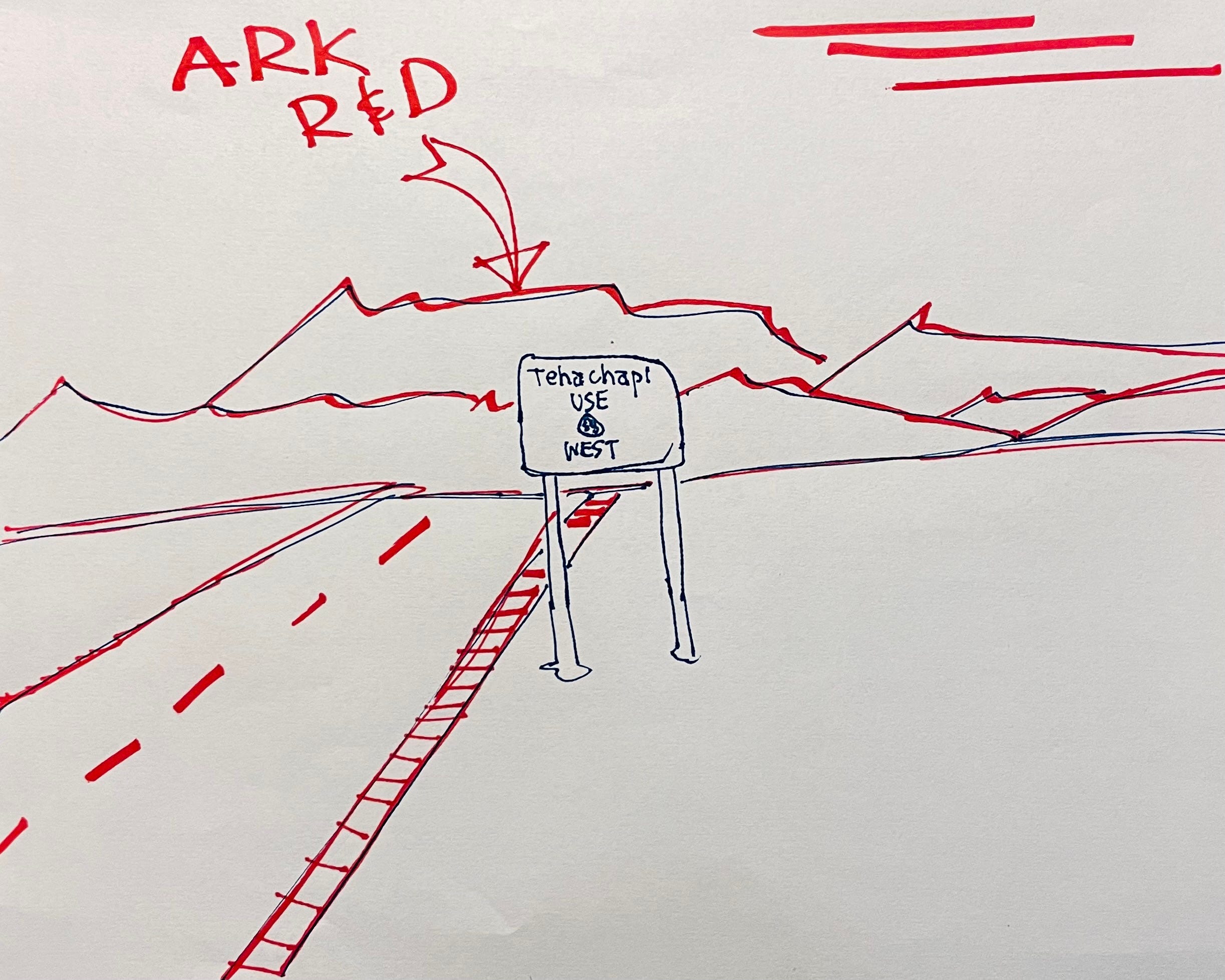
It took us about another hour to climb to the top of Tehachapis. For a time, we had to leave the highway to get around a washed-out section that lasted for miles, backtracking down the hill and doing a big loop. When we finally got back on the highway, Tommy suddenly perked up and swiveled his gun. “Easy there, kid,” Billy said, and let out a few deep honks on his airhorn. The same pattern — short, short, long, short — came back to us from the approaching cars. Tommy relaxed. “It’s a friendly. Probably making a supply run to Bakersfield,” Billy said to me. The caravan passed us going the other way — two big trucks flanked by modded pickups like the one we were in. Still, Tommy kept his hands on the swivel gun at the ready. “We change the codes every few days. But you never know…”
The Jewish incident behind us now, Billy and Tommy got talkative on the way. I found out that Tommy was Billy’s nephew. Their family — their extended clan — had been in California since the Gold Rush. “Story is my great-great grandfather killed a man in Arkansas and fled out west on one of those wagon trains and did some mining but the fucker didn’t have any luck. So he ended up staking claim on a chunk of land in the foothills out by Sacramento, farming and raising cattle,” Billy said. “Rumor’s that we got some Indian in us, too. The old goat worked his way through three or four wives and one of them was a half-breed.”
“I got a little of that ferocious native blood in me. I can feel it,” Tommy added, excitedly.
“Old goat killed bunch of Indians, too,” Billy said, smiling. “I remember grandfather telling me about the scalps they had hanging over the fireplace when he was a kid. They drove those poor bastards up into the mountains to starve them out. So they took to stealing cattle to eat. But that couldn’t be. They had to be punished.”
I’ll keep publishing RADIANCE first drafts as the novel progresses.
Read previous chapters here.
“Where’d it hang? At the Fresno house,” Tommy said.
“No, the one in Los Banos. The one that burned down.”
Back before the war, when these distinctions mattered, Tommy and Billy would have been considered hicks by the coastal professional class. They talked with an almost southern drawl, barely finished high school, cursed, smoked, dressed in hunting gear. I could imagine these guys with their families back before the war — their rural houses on several acres of land somewhere up in the mountains, a couple of giant trucks, an ATV, and a Harley parked out front. There’d be an RV, too. And boat of some kind parked on a hitch. They’d own a construction business, their uncle would own a car dealership, a cousin would be an ex-Navy Seal meth addict with PTSD who’s in jail for beating up his wife. Coastal types — when they’d run into them at a gas station while on a family holiday to Yosemite or when getting work done on their vacation home in Tahoe — would look down their noses at Billy and Tommy…but they’d also fear them. And envy them, too. Deep inside the mind of the professional class, these specimens were a reminder that there were people out there that had not been fully housebroken…there were people who could still do something autonomously on their own. It was not even true but it didn’t matter. It appeared as true.
