
When the Pentagon hoped Noam Chomsky would help build AI weapons against communists

With this new Jeffrey Epstein Spectacle drop, everyone is once again buzzing about Noam Chomsky and his relationship with The Pimp to Our Unfuckable Elites. How is this guy — with his sharp, computer-like mind and his supposed keen sense of morality — palling around with such a shady, nefarious character?
I’ve appreciated some of Noam Chomsky’s work, and I know he was important to the intellectual development of several generations of people — writing widely available books that critiqued American power and gave people insight into its structure and function. For many he was their first entry into critical political thinking about their own country. But I noticed there was something strange and compartmentalized about Chomsky’s thought process. It was years ago, while I was working on my book Surveillance Valley, that I first picked up on it.
What struck me as strange about Chomsky was this: In the 1960s and 1970s, he emerged as a mainstream critic of the American Empire — first and foremost by being against the Vietnam War and critiquing the intellectual bankruptcy of American intellectuals, technocrats, and academics (whom he frequently called “mandarins”) who were trying to give aggressive imperialism a progressive and positive spin. What was interesting was that he went after the early computer-crazy technocrats who wanted to use early computers to create political weapons: systems for the monitoring, predicting, and controlling of societies. These were the people who dreamed of creating the cybernetic, constantly surveilled and manipulated Vampire Valley world that we all live in today. And yet I also discovered that, at the same time, Chomsky was in his own small way helping to create Vampire Valley. His work was directly funded by the same imperial security apparatus that he was critiquing — an apparatus that wanted to put a digital layer over the entire world.
Specifically: Chomsky was pursuing a very particular kind of theoretical linguistics — a linguistics that treated the mind as a computer and language as an algorithm. He was at MIT, which basically was an extension of the Pentagon. And his work, not surprisingly, was funded by the Pentagon — by the US army, navy, and air force, and other related arms of the imperial state.
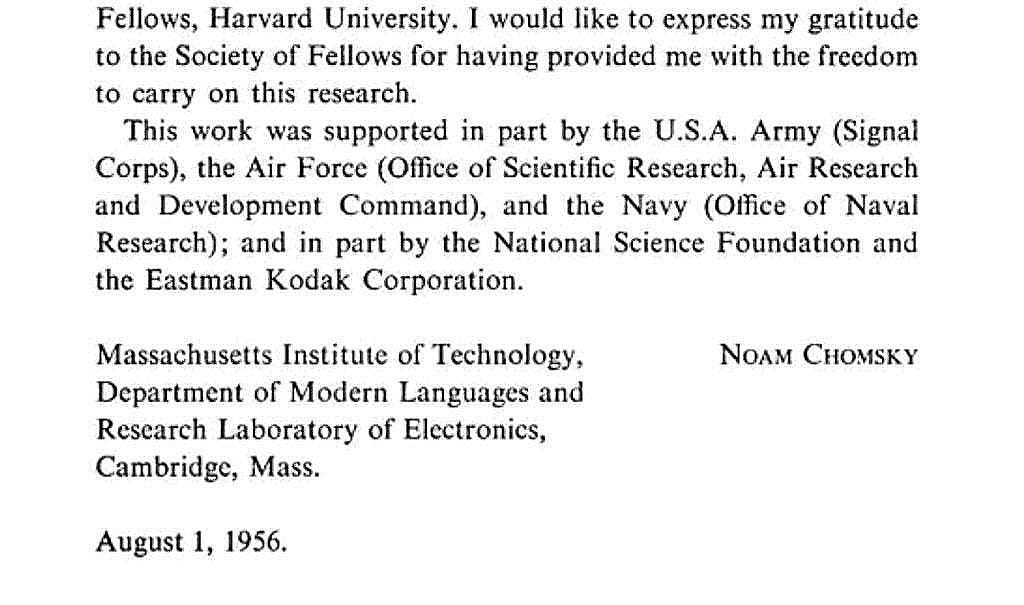
From his groundbreaking “Syntactic Structures”
The reason these entities funded his linguistics? As I write about it in my book:
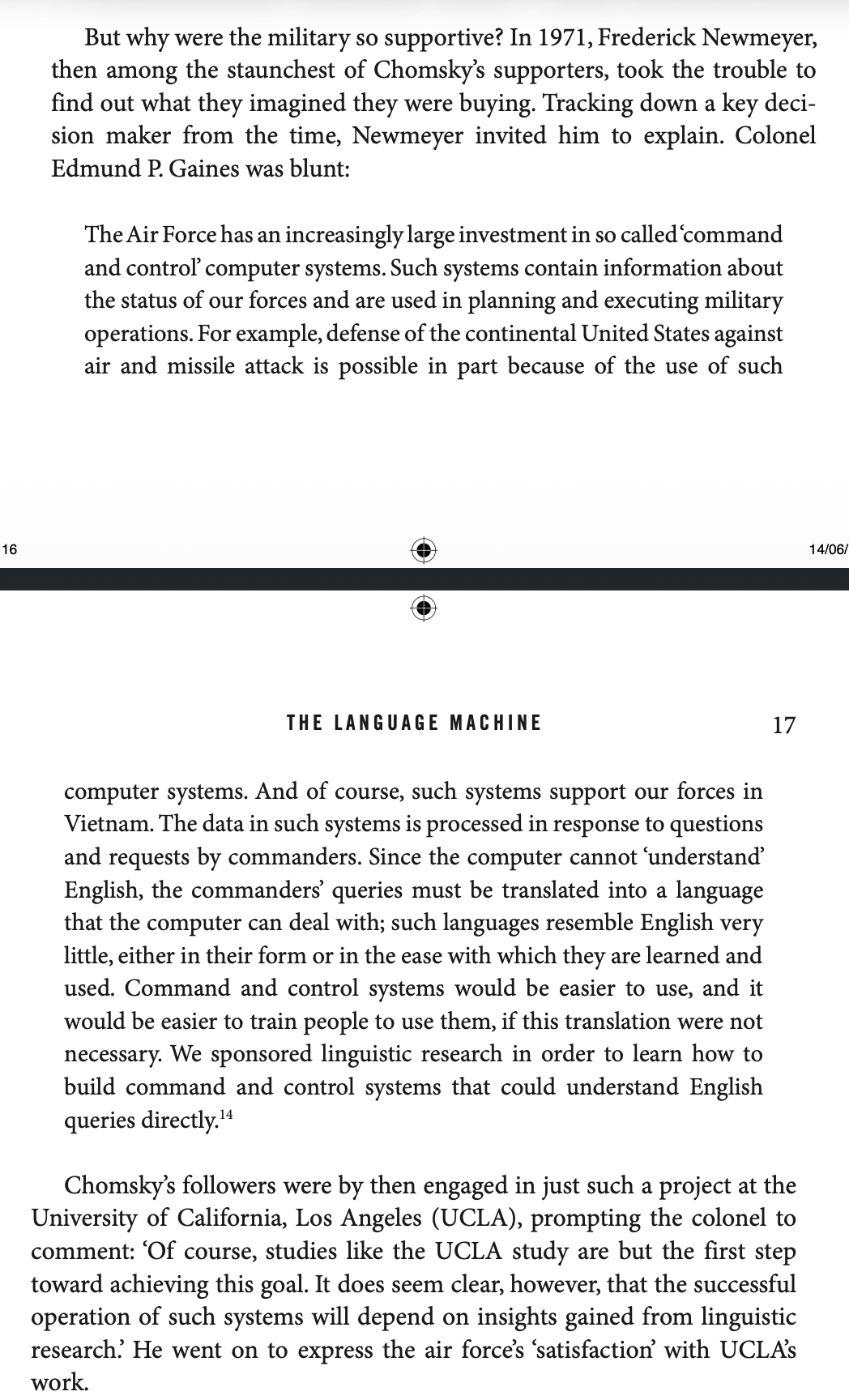
He rose to fame by redefining the study of linguistics, and helped spark the “cognitive revolution” by positing that human language was produced by what was essentially a specialized language computer module in the human brain—like a sound card plugged into a mother board. He theorized that language could be boiled down to logical expressions, which was the foundation of computer language. His linguistic work at MIT in the 1950s was funded by the army, navy, and air force in large part because the military wanted to develop computer technology that could process human language on the fly in order to analyze intelligence intercepts, to process press reports, and to understand human commands.
This was no minor thing. At the time, the military was plowing many Manhattan Projects worth of resources into developing and weaponizing all sorts of computer systems — for missiles and radars and intelligence gathering and psychological and cultural warfare. The internet and personal computers and all the AI stuff we’re seeing now were part of this larger project. And to paranoid security state bureaucrats calling the R&D shots back then, Chomsky’s linguistic work would help move the needle and bring this reality into being. Or to put it another way: They thought it would help them create the ultimate early AI weapon against the commies!
I studied Cognitive Science at UC Berkeley. And I took a linguistics class — a class basically teaching Chomsky’s theories as gospel. And I very clearly remember sitting in a café doing these algorithmic-type universal grammar sentence analyses for my homework and being very confused by the nonsensical uselessness of it. You deconstruct a sentence to the point that it has no meaning. And so what? Only later did I realize that there was a reason why it felt like this approach to studying human language was made for computers: it was. Chomsky helped trigger the cognitive revolution in psychology — a “revolution” that posited the best way to understand the human mind is to think of it as a digital computer…a development that was essentially funded by the Pentagon because it aligned with its larger drive to turn the world into a giant surveillance machine. I only realized this later, when I was writing my book.
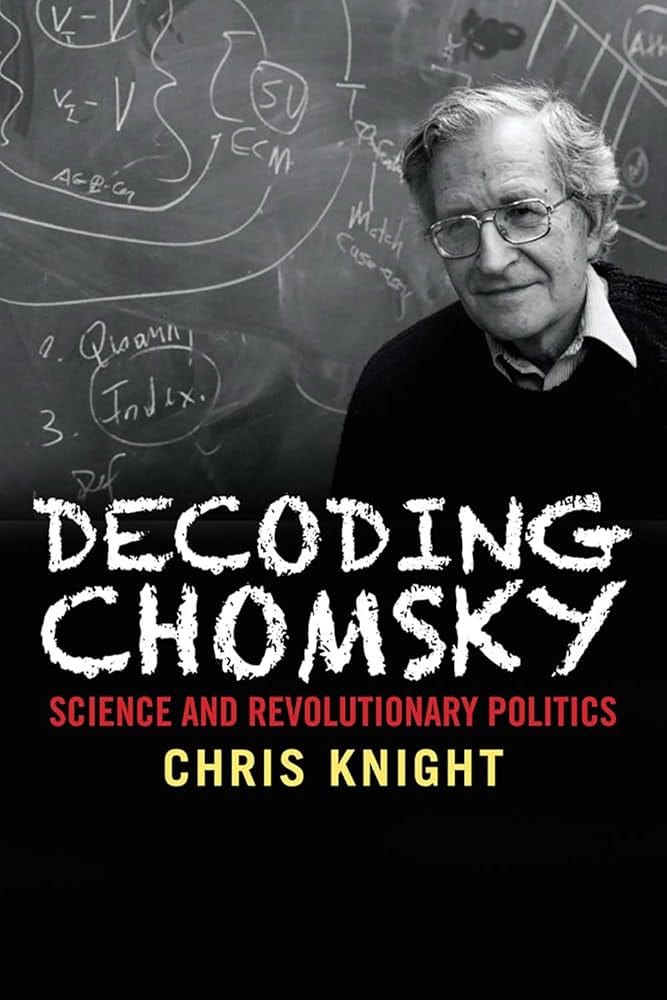
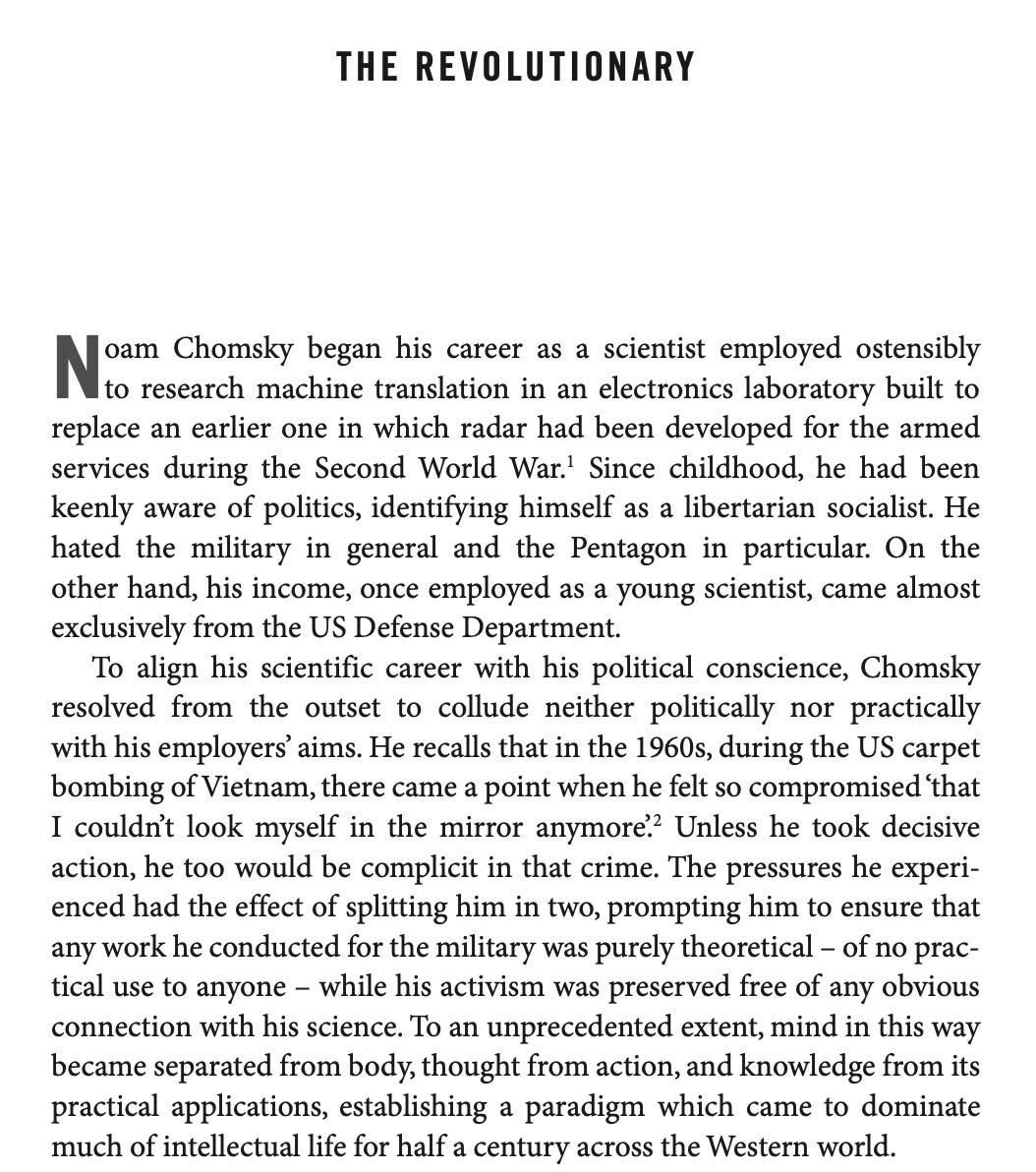
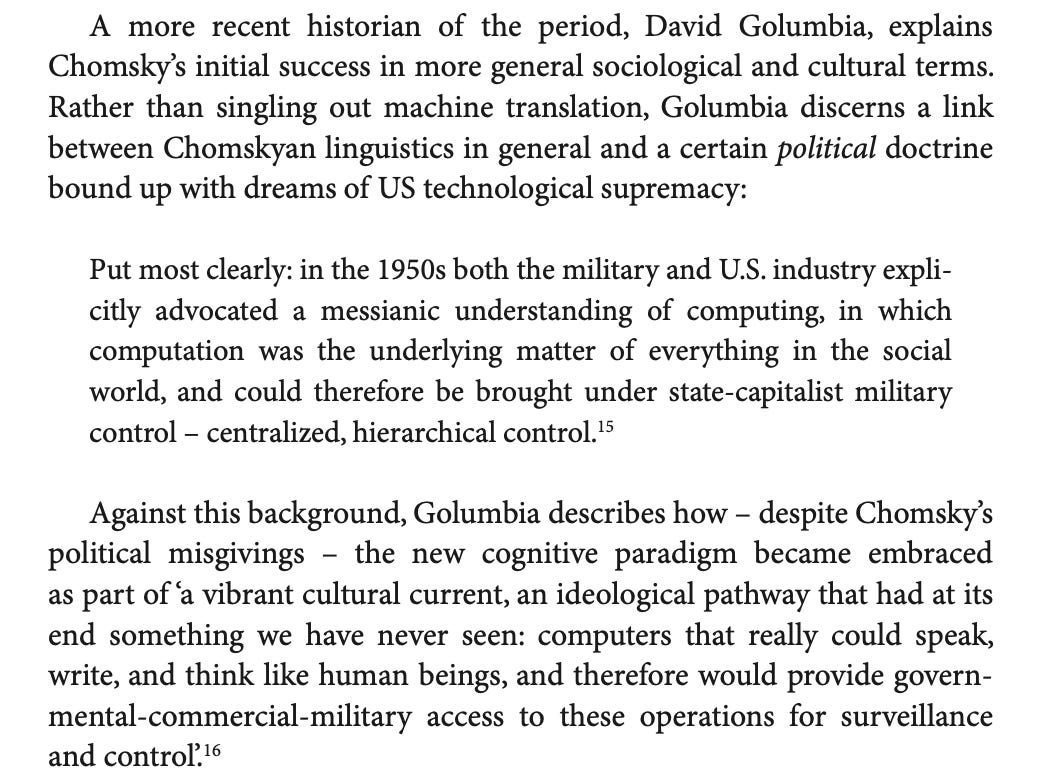
This split in Chomsky’s brain — the radical and the early AI weapons guy — was best explored by Chris Knight in his book Decoding Chomsky.
…
…
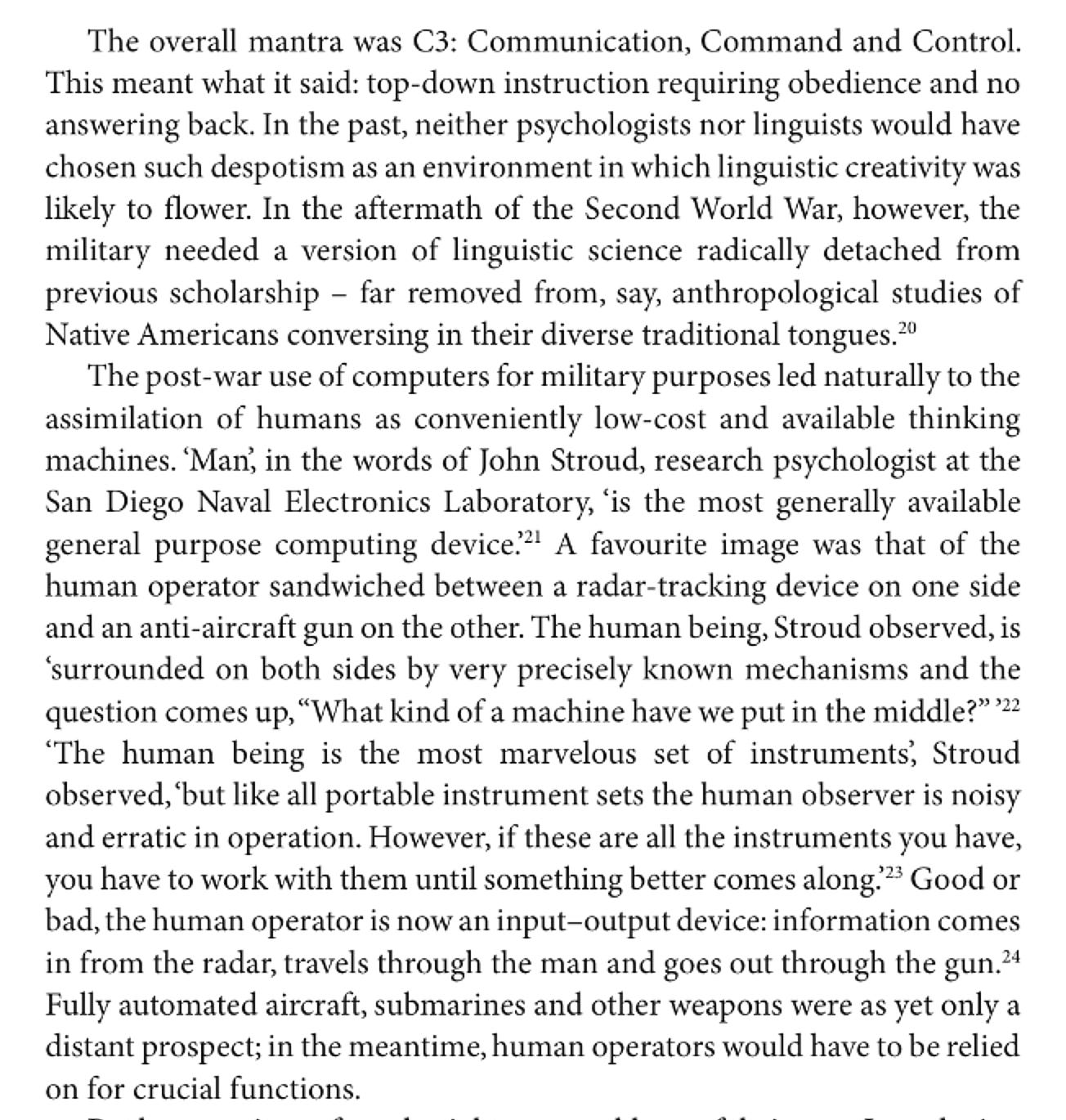
Decoding Chomsky was a wonderful and unexpected book. It used Chomsky as a kind of foil to look at the world of post-WWII American security state academia and its obsession with integrating everything into computer systems. The book ranges across all sorts of seemingly unrelated regions, too: Cold War fantasies of global control, Russian Revolutionary poets, the origins of linguistics, the dream of discovering a universal human language… About Chomsky, the book is pretty clear: He was distraught at being part of the Pentagon machine and so he simply denied that his work had any politics to it. His linguistics was pure…hovered in the clouds…untainted by this world. He compartmentalized that side of his life’s work.
I mean, look at how he described his Pentagon funding during a talk he gave: The military guys were idiots who had no idea what you were doing. In fact, he claimed that the more military money a university got, the more radical it was!
This is from Understanding Power, a book that reprinted some of Chomsky’s speeches and public appearances:
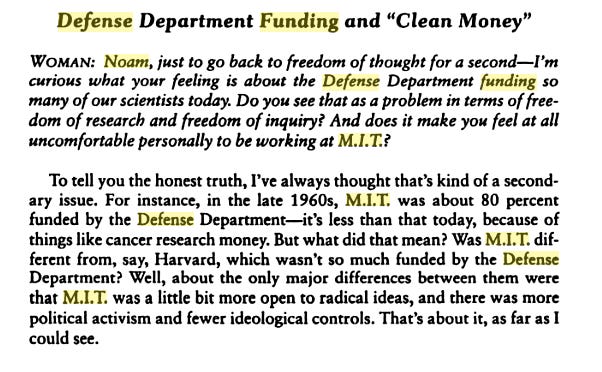
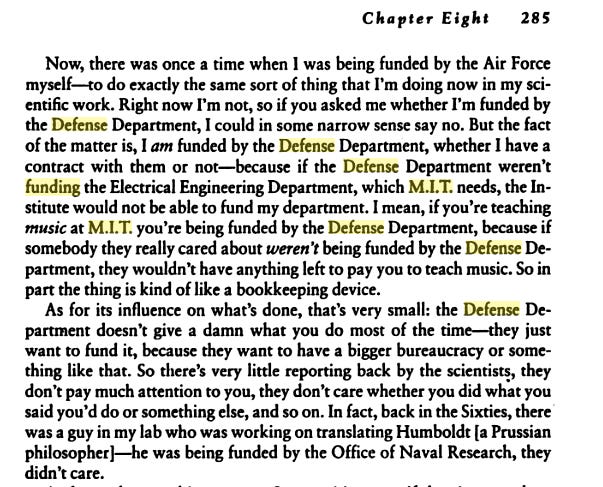
I mean, this is a clear obfuscation — he’s lying to himself and others. It is no surprise that being awash in military money gave you the most freedom. You are the most elite worker in American society, directly contributing to weapons system development…helping protect the American Way of Life from Godless Communism. You were doing technology in a society that held technology above god — you were part of an anointed priestly class, working in the holiest of holies, given wide latitude to do things as long as the higher-ups thought it could be put to use.
And yet, of course, linguistic theories aren’t disconnected from political considerations. Even outside their potential usefulness to the military in computerizing warfare and intelligence gathering, studying human language as if it can be reduced to code running on a digital computer is a political idea at the highest level of politics: it promotes a certain view of humanity…namely, that we are machines…that we can be reduced to ones and zeroes…that our bodies and minds can be integrated seamlessly with a weapons system or an oil refinery or a vacuum cleaner. That kind of view of society promotes the creation of a certain kind of society…with certain values and technologies and social structures.
Another part of Chomsky’s personality that went against the moral and down-to-earth and egalitarian image he took pains to craft for himself in the political part of his life was this: He was vicious with any linguist who dared question or critique the validity of his linguistic theories. There’s a whole other book written about it — the Linguistic Wars — that goes into it in great detail.

I haven’t read the book in over a decade, but I recall that it describes Chomsky using his god-like stature in the world of linguistics to destroy the careers of any dissenters — fellow academics and former students and/or friends who critiqued Chomsky’s pure logic approach to language and offered their own counter-theories.
So here Chomsky, this egalitarian anarchist guy acting like a total tyrant when the correctness of his theories and his life’s work were called into question. To me it’s another example of this split-brain behavior: The political guy who wants socialism and peace on Earth and the Pentagon-funded academic obsessed with his prestige who tolerates no dissent.
It’s funny, too, because Chomsky’s detractors were proven largely right: his search for Universal Grammar has been discredited. The way LLMs handle language is through pure statistics and brute forcing massive amounts of data. So the paranoid Pentagon bureaucrats had backed the wrong horse with Chomsky. But it didn’t matter. Chomsky was still very useful. He helped push the larger field of psychology in the right direction: towards studying minds as computers. So he paid for himself many times over.
As far as Chomsky and Epstein. Well, who knows what that’s about. Maybe he was flattered by the attention? Maybe he liked to hang out with weird and interesting characters? Maybe it’s just an elite and celebrity thing — it’s a tiny class and the people at the top are more comfortable hanging with each other than the peasants? Maybe he was starting to get senile? It does appear that Chomsky seemed to not believe or care about the media hype around Epstein, chalking it up to smear campaigns and MeToo hysteria. It wouldn’t be surprising given how much Chomsky himself was smeared and attacked in the press — and he basically wrote as much to Epstein at some point. In Chomsky's defense, he was like 90 when he wrote to Epstein, counseling his new friend to stay low and let the rapist allegations blow over. Most people, if they are lucky to live that long, can't wipe their own ass at 90, let alone make complex judgements about character and context. So…
Still, that aside, Epstein was probably not the best guy to pal around with if you’re trying to maintain a position of morality from which to lash and whip America’s unaccountable elites. Epstein was a creature of those elites — he is just one tiny example of what happens in a society where power is concentrated in the hands of a super-minority. The fact that an Epstein existed in America is not surprising. He is gone, but no doubt another 1,000 Epsteins will take his place…
I guess the reason I bring this other Chomsky history up is to offer an example of how people are not logical. Chomsky’s theories posited that something as core to life as language can be boiled down at a deep level to pure logic — a set of rules that can modeled on computers. But here, with Epstein, Chomsky clearly breaks his own moral logic, depressing all his fans and exciting his critics. It just goes to disprove the whole rationalist/computer approach to understanding life. We are not machines. Our minds are geared for fuzzy thinking, compartmentalization, denial, illogical rationalizations. Everything depends on social context. Everything is relative to something else. No one lives in absolutes. I guess it’s why politics is so hard and messy. We’re not machines. We’ll never be. No matter how much they want to train us to be machines.
—Yasha
I’m raising money to make VAMPIRE VALLEY, a doc series about the internet. Any donation over $100 automatically gets you annual subscription to this newsletter! Give here or get in touch with me directly to make a larger tax deductible donation. Thank you!
I was going to comment on this, but then saw that you addressed it in your closing paragraph.
Still, a small observation, just because I like discussing this:
"It’s funny, too, because Chomsky’s detractors were proven largely right: his search for Universal Grammar has been discredited. The way LLMs handle language is through pure statistics and brute forcing massive amounts of data. So the paranoid Pentagon bureaucrats had backed the wrong horse with Chomsky. But it didn’t matter. Chomsky was still very useful. He helped push the larger field of psychology in the right direction: towards studying minds as computers."
Chomsky's Universal Grammar was _not_ discredited by LLMs working differently. It was, rather, discredited because there is no experimental evidence at all for the existence of Chomsky's "language module" in the brain, and because his theory's predictions regarding the behaviour of the world's languages is not what is observed. _And_ because people working in current neuroscience and biology don't believe that the brain behaves _at all_ like a computer, and certainly not like a digital one (as Chris Knight also points out).
LLMs couldn't discredit Chomsky's theories, because they also don't work at all like the human brain - given that they do inference from humongous amounts of data, while humans learn languages from rather limited amounts of input. Also, LLMs don't have anything at all of what we usually call "insight" or "understanding".
And, of course, studying minds as computers was never the "right" direction for psychology for anybody except the Pentagon people and technocrats, but that's also what you write at the end. Treating the mind as a computer is convenient if you want to simulate it on one, but this metaphor gives no real understanding of what's actually going on in people's messy, non-digital, relational minds.
The parallel to Silicon Valley's much-lauded concept of "disembodied mind" is striking, though: Silicon Valley stars from Stewart Brand to John Perry Barlow used to rant on about the possibility of "disembodied mind", or even "uploading your conscience". But what we understand as "mind" or "consciousness" can probably only ever be embodied.
Which is a nice philosophical discussion for another day :-)
there's a grim irony to how seemingly all these soft power weapons funded by the DoD boomeranged right back into the domestic populace. Machine translation didn't beat the Russians or the Chinese - it has eviscerated the fields of translation and interpreting altogether in my lifetime and within about a decade you're simply not going to have people learning other languages, which has the net effect of further entrenching divisions with other foreign cultures.
Some would argue that this is in fact been the entire point and they are right - since what use is the department of defense (or DoW under Hegseth i suppose) if there is peace.