
California's war on Iranian pistachios

Pistachio gangsters Lynda and Stewart Resnick
The most recent American-Israeli war on Iran has been designed to cripple Iranian society — schools, hospitals, apartment blocks, airports, and pretty much all important economic infrastructure. And last week, this campaign took (for some) an unexpected twist: Israel and America struck pistachio infrastructure in Iran’s Kerman province, the center of the country’s pistachio industry.
Are these US-Israeli strikes on pistachios being done on purpose? To anyone who has read my work or watched our film Pistachio Wars, it wouldn’t be a surprise if they were. The big pistachio lobby in California is just one business interest among many doing its part to keep America’s foreign policy aggressive and murderous.
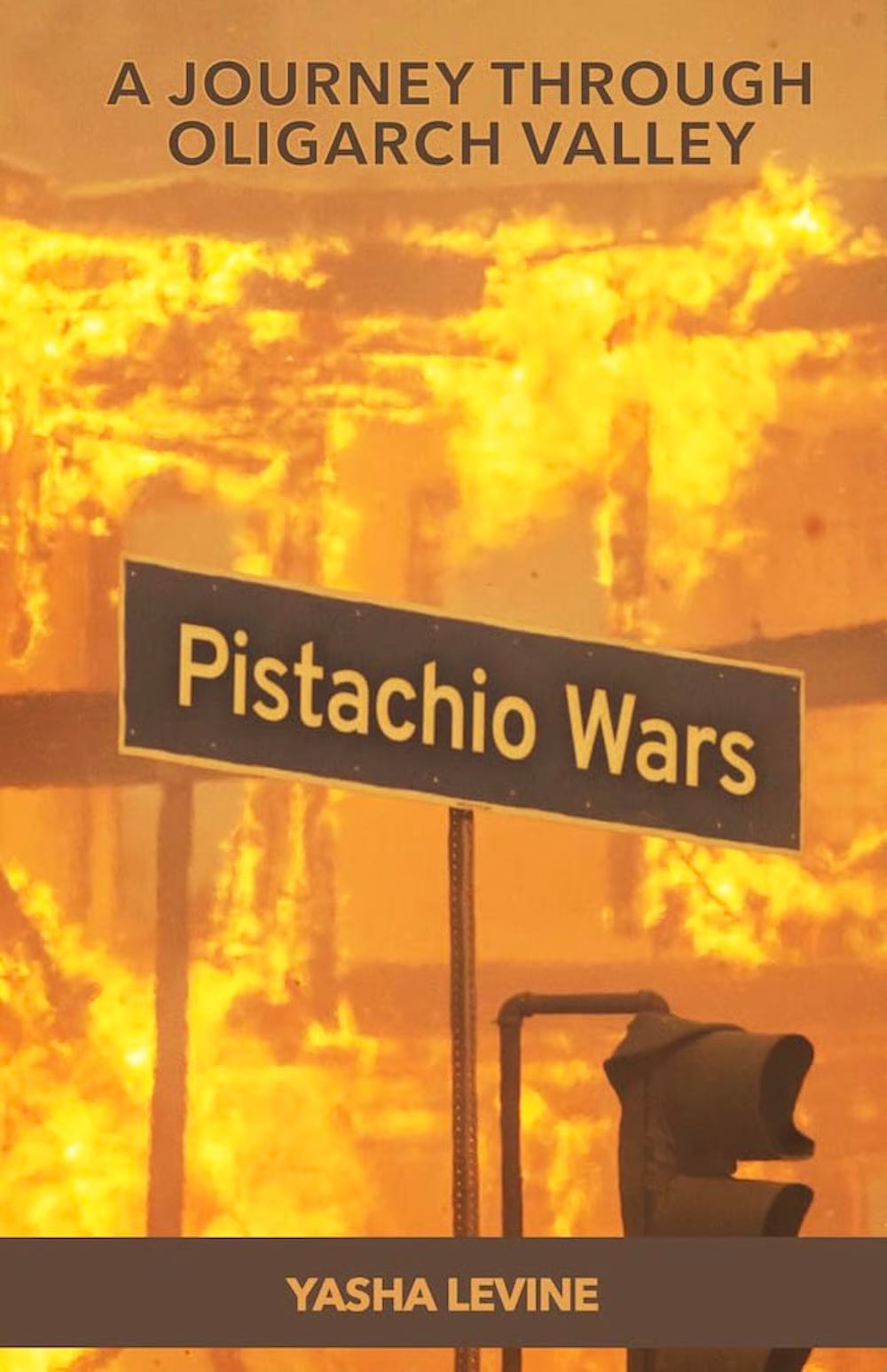
I’m sure you want to know a bit more about the history of the pistachio industry in America and why it depends on destroying Iran. So I thought I’d repost a chapter from A Journey Through Oligarch Valley, a travel guide I wrote back in 2013 — targeting the misanthropic tourist who wants to explore the toxic dark heart of California, rather than the usual boring sights like the Golden Gate Bridge or Yosemite. This chapter’s about Lynda and Stewart Resnick, the Beverly Hills couple that made California into a global center for pistachio production and made billions in the process…and have been lobbying for war with Iran.
You can buy the full recently reissued book on Amazon — or, if you are in the United States, order a signed copy from our humble little publisher. And of course…watch Pistachio Wars today!
RESNICKS (EXIT 253)
Driving north at NASCAR speed takes me to the home turf of one of Oligarch Valley’s newest and oddest landlords: Beverly Hills agri-billionaires Lynda and Stewart Resnick. You might not recognize the name, but you’ve certainly seen their luxury Fiji Water bottles at your local 7-Eleven, or maybe you’ve seen Palin family dropout Levi Johnston hawking the Resnicks’ Paramount brand pistachio nuts on TV. If nothing else, you’ve eaten their Sunkist oranges.
Fiji Water comes from Fiji, but just about everything else the Resnicks sell comes from Oligarch Valley, where they preside over several hundred square miles of land. A large chunk of their of their empire straddles Highway 33, just north of Taft and right next to the gas station where James Dean stopped for a Coke right before ramming his souped-up Porsche racer head-on into a hapless university student driving a Ford Tudor.
The Resnicks bought this land from Mobil and Chevron decades ago, and transformed the oil-stained desert into lush farmland filled with hundreds of miles of leafy green almond and pistachio orchards. The trees are planted with space-age precision—a perfect grid as far as the eye can see, whose countless rows recede endlessly in the horizon. At the center of it all is a giant factory with rows and rows of gleaming metallic silos where the company preps, packages and distributes its foodstuffs.
The scale of their farm numbs the mind. It’s a small self-sufficient settlement and includes its own small airport—how else do you expect Oligarch Valley farmers to get around? And this piece of farmland is only one small part of a diversified global agribusiness operation that brings in $3 billion in revenue a year.
But here’s the fun part: the continued economic viability of this piece of Oligarch Valley depends on Iran being kept in a state of a permanent economic blockade.
It depends on it so much that the Resnicks have joined forces with raving neocons and hardcore rightwingers, funding think-tanks and lobbyists that hype the Iranian threat and push all out war.
I stumbled onto Stewart and Lynda Resnick almost as soon as I started investigating California’s billionaire dominated public water system. The Oligarch Valley family that had made an easy $74 million selling water to the desert subprime suburb of Victorville was closely connected to the Resnicks. Both families owned shares of the Kern County Water Bank, a natural aquifer at the southernmost edge of the Central Valley that had been converted into a privatized water storage facility.
The water bank was designed by California’s Department of Water Resources to function as an emergency reservoir. In wet years, it would collect excess water shipped down the California Aqueduct from Northern California and hold enough water to keep Los Angeles hydrated nearly two years in case of prolonged drought.
The water bank was supposed to serve as a last-line defense to protect urban users. But in 1995 California water bureaucrats tweaked a couple of arcane water regulations and handed the water bank over to a small clique of Oligarch Valley landlords.
Once water entered the water bank, it stopped being a public resource. From that point, the owner could sell it to the highest bidder. “This means they become middlemen making profits on state-supplied water,” reported Redding’s paper Record Searchlight. “If they choose to, they can dry up vast areas of productive agriculture and ship the water to municipalities south of the Tehachapi range.”
Stewart Resnick masterminded the scheme, and emerged with a majority stake in the new Kern County Water Bank. In fact, the Resnicks dominated and controlled the water bank so thoroughly that it’s become a de facto extension of their private agribusiness. They run it out of one of their corporate offices near Bakersfield, California.
Resnick’s scheme did more than privatize a single piece of public infrastructure. It created a novel legal framework that gave Oligarch Valley famers the power to create nonexistent water out of thin air. Resnick created “paper water.” Like the leveraged subprime-backed securities and exotic debt instruments dreamed up by Wall Street, “paper water” was built on pure fantasy and innovative accounting fraud. The simple fact was that half of California’s “paper water,” water able to be sold, bought and traded on the market, simply does not exist, and never has.
It sounds nuts, but it’s true. And it all has to do with the California State Water Project started by Governor Pat Brown. The project involved a series of dams, aqueducts and massive water pumps to siphon water from Northern California and to send it down through Oligarch Valley and into Southern California. When the system started being built in the 1960s, the state allocated guaranteed water rights to farmers throughout Oligarch Valley. These contractual obligations were not based on reality, but were worked out using the estimated capacity of a fully built-out state water system. And that was the problem: the State Water Project was never fully completed. Attempts to dupe California voters into paying for the final parts of the system have been tried on many occasion, but have yet to succeed. Contractually, the state was obligated to deliver 4 million acre-feet a year. But in reality, the state could only deliver half the water it promised.
